


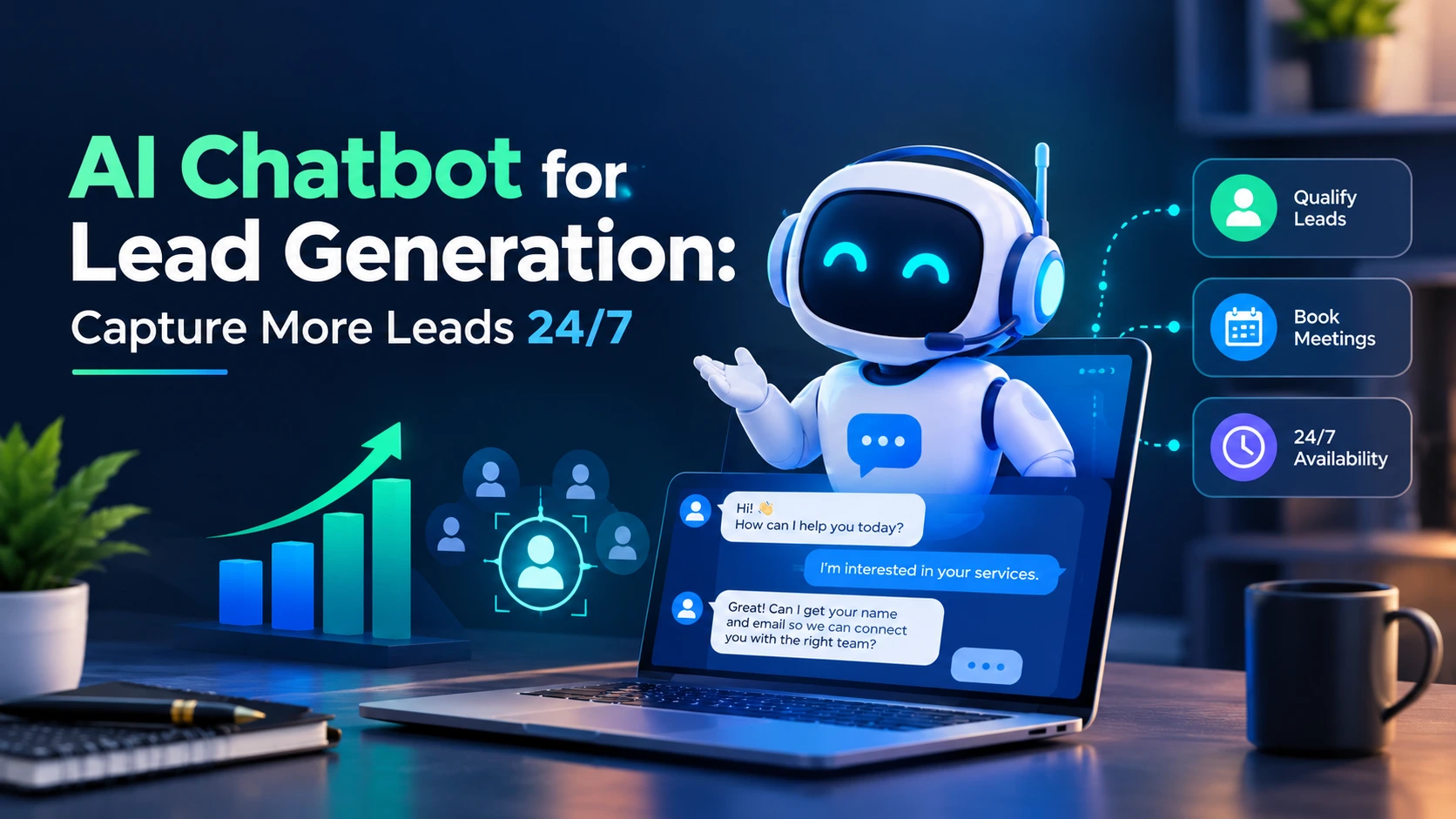
AI Chatbot for Lead Generation: The Complete Guide for Growing Businesses
An AI chatbot for lead generation is a chatbot that communicates with visitors on your website in real-time, asks questions to determine if they qualify, collects information and passes along the lead to your sales team. It initiates the dialogue for you, 24/7 without requiring visitors to complete a form.
If you’re playing in the online arena, you better be quick and relevant or someone else will get the lead. The visitors do not want a delay in response and every unanswered question is a lost opportunity. This guide will cover the inner workings of lead-focused chatbots, its significance, the features it offers, and how to create a lead-focused chatbot to actually increase your pipeline.
Why Businesses Need an AI Chatbot for Lead Generation
Old school lead capture is based on stationary forms and landing pages. They are passive, they introduce friction, and they only serve those visitors who are already motivated enough to complete them. All the rest leave stealthily and you never get to know who they were or what they wished for.
Chatbots turn that on its head. They welcome visitors depending on the page they are on, provide answers to common inquiries immediately, and direct visitors to a next action like scheduling a demo, requesting a quote or downloading a resource. The exchange is quite like a conversation, so visitors share more and your team gets helpful context with each visitor.
Today, this is particularly relevant with three shifts:
- Buyers research independently. Most prospects look into these choices without asking anyone and as soon as they get a helpful answer the relationship is won.
- The speed of response to an emergency is a key determinant of success. Leads that respond to your call promptly are far more likely to be interested than leads who wait hours or days for a response.
- Search is moving to conversational. Now they ask full questions in search engines and AI assistants, and so do they expect from your website.
The working principle of a Lead Generation Chatbot.
Today, Chatbots can utilize business rules and your own content, along with natural language understanding. There are 5 steps in a typical conversation:
- Engage: Bots start with relevant, page-specific welcome message rather than the default “How can I help?” message.
- Qualify: It asks brief questions regarding needs, budget, timeline, company size, or location to determine the visitor’s fit.
- Capture: It asks for a name, e-mail or telephone number once value has been given.
- Route: Hot leads are immediately forwarded to a salesperson or a calendar link is provided to schedule a call.
- Nurture: Lower intent leads are added to an email or retargeting nurture sequence for follow-up.
AI bots are more intelligent than traditional rule-based bots, which become ineffective when a customer encounters new situations or questions.
AI-powered bots go beyond just breaking when a visitor steps out of the script, as they can comprehend intent, respond to additional questions, and adapt to new scenarios based on previous interactions. It’s this flexibility that makes a regular chat window into a dependable lead engine.
The benefits of employing an AI Chatbot for Lead Generation are significant.
- Always-on availability. A chatbot is always on duty. The visitor arriving at night, at the weekend or off the hours of service are treated exactly as those during normal business hours.
- Better lead quality. Suitable prospects are filtered out before they get to your sales team. Reps dedicate time to discussions that do lead to conversions.
- Higher conversion rates. Conversations reduce friction. Someone who wouldn’t fill out a seven field form will often answer 3 quick questions when chatting.
- Reduce lead cost. One chatbot can manage hundreds of conversations at a time – meaning you get more out of traffic you already pay for, and you save on having to recruit additional employees.
- Richer data. Each chat provides insight into customer inquiries, concerns and any pages that are confusing. Those insights help you make your Web site better, your ads better, your sales script better!
Key attributes of a lead generation chatbot are:
Not all tools are designed to be used in sales. The top AI chatbot for lead generation should feature:
- Natural language understanding so it is able to understand real questions not just button clicks.
- Tailored training for your content such as service pages, pricing details and FAQs to ensure answers remain relevant and consistent.
- CRM and email integration with platforms like HubSpot, Salesforce or Zoho, so that leads go straight to your pipeline.
- Calendar booking to convert the interest into a scheduled meeting without back and forth e-mails.
- Smart conversion to human when a discussion is complicated or a lead is ready to purchase.
- Save time on lead scoring & tagging using priority settings.
- Multi-channel support on your site, WhatsApp, Facebook Messenger & Instagram.
- Analytics dashboards that provide engagement, capture and conversion data.
Real-world applications in various industries.
The chatbots that include lead generation are flexible and can be utilized for a variety of company models. Leading agencies can use an AI chatbot to schedule consultations, qualifying SaaS to request demos, pre-screening education programs, collecting details of projects for house services, or answering inquiries from real estate listings. It can also collect emails for ecommerce brands by providing product suggestions or coupon codes, and then reengaging with abandoned carts.
It’s all about the same equation: when a prospect has questions before they make an investment, a chatbot can provide those answers at that very moment.
Let’s get started by learning how to set up your Chatbot step-by-step.
It’s not very difficult to get an AI chatbot for lead generation up and running, but it does need planning.
- Establish a clear objective. Choose between booked calls, quote calls, email registrations, or qualified phone numbers. A major objective will keep the discussion on track.
- Construct a profile of your ideal client. Write the questions that distinguish between strong and weak leads and then convert these questions into brief questions that function as “mini” conversations.
- Write the conversation flow. Be friendly and welcome in your message, be page relevant, stick to the point and provide value first so they can provide you with their contact information.
- Train it on your knowledge base. Upload FAQs, service descriptions and pricing guidance to let the bot respond with confidence and accuracy.
- Connect your tools. Make sure your CRM, email and calendar are integrated to never miss a beat with follow-up.
- Test before launch. Become the customer and run the chat as such, ask some unusual questions and eliminate any dead ends.
- Start, track and improve. Check and tweak wording, questions and triggers every week according to actual behaviour.
The following are common mistakes which should be avoided:
No matter how robust the AI chatbot is, a weak lead generation strategy will result in subpar performance. Be aware of these potential “traps”:
- Seeking contact information too soon. Provide assistance before asking questions.
- Overly long conversations. A drop-off occurs with each additional question. Limit the number of qualification questions to 3-4.
- Imitating humans. Be transparent that visitors are chatting with an AI. Honesty builds trust.
- No human fallback. Make it simple for visitors to reach a real person at all times.
- Set and forget. Chatbots are continually reviewed and updated.
How to Measure Success
Monitor just a few key statistics to determine if the chatbot is working its magic, including conversation-to-lead, qualified lead percentage, meet booking rate, average response time, and cost per lead. Compare these with your form based results. Also consider the conversion of leads to customers over time to ensure leads are not only abundant, but valuable.
Conclusion
Visitors want answers quickly; they want them helpful and they want the business to keep coming with good prospects in the door. By bridging these two areas, an AI Chatbot for Lead Generation can start the conversation with consumers the moment they express interest, qualify them using natural dialogue and funnel the most suitable leads straight to your sales staff, all without delay. Have a clear objective in mind, use it for a brief and honest experience, embed it into your CRM, and tweak it with actual conversation data. When done correctly, it can be one of the most effective components of your marketing funnel.
At GSS Tech, we can assist businesses in integrating smart automation and search-optimized content to help them attract, engage, and convert more customers. Looking for converting leads from your website? Get in touch with our team to get started.
Frequently Asked Questions
What is a lead generation chatbot?
A lead generation chatbot is a software that converses with visitors to your website, asks the right questions to qualify them, gathers your contact details, and routes them to your sales team or calendar.
How does a chatbot qualify leads?
Asks specific questions to determine visitor’s needs, budget, timeframe and role, and scores the answers against your ideal customer profile. High scoring leads are passed over to the sales team right away, whereas others undergo a nurturing sequence.
What is the price of an AI chatbot for lead generation?
The price is dependent on the features and volume. The entry-level ones have a lower monthly subscription, while the advanced ones that offer custom training, CRM integration and multichannel support are much more expensive. Most businesses go with a plan depending on conversation volume and integrations required.
Will chatbots take the place of my sales team?
No. A chatbot answers the first questions, repetitive queries and qualifies the leads to enable your team to focus on the relationship building and deal closing process. In sales, follow-up with people is still needed for more complex or high-ticket sales.
Can a chatbot be integrated into my CRM?
Yes. The majority of platforms integrate with leading CRMs like HubSpot, Salesforce and Zoho, which means leads and notes from conversations are automatically synced.
What’s the time of setup?
A basic chatbot is ready to go in a few days. Usually takes 1-3 weeks to setup fully customised with CRM integration, trained responses and tested workflows.
Does a Chatbot work well for small businesses?
Yes. A chatbot is particularly advantageous for small businesses, as it captures leads 24 hours a day at no extra cost for hiring.