


Marketing Automation Services: How to Nurture Leads and Grow Revenue on Autopilot
Marketing automation services enable you to manage your campaigns automatically throughout, from when your visitors are interested in your products to when they buy them. Emails get sent on their own, leads get scored and routed, follow ups get done on time and done every time without your team doing it by hand.
Automation can fill the gap if your site receives traffic and not many of those visitors are converting to enquiries or if your leads are frozen because they are not followed up quickly enough. It provides an overview of what these services are, how they operate, what they can achieve, the pricing and how to find a trusted provider.
So, just what are Marketing Automation Services?
Marketing automation services help plan, construct, and manage your marketing automation campaigns professionally through your marketing channels. The provider installs the platform, integrates it with your website and CRM, creates workflows, develops the messaging, and tracks performance to ensure your campaigns continually improve.
Separating the tool from the service is important. You have the technology, like HubSpot, ActiveCampaign, Mailchimp, and Klaviyo. The service is the strategy, configuration, content and tuning that actually generates leads and sales from the technology.
How Marketing Automation Works
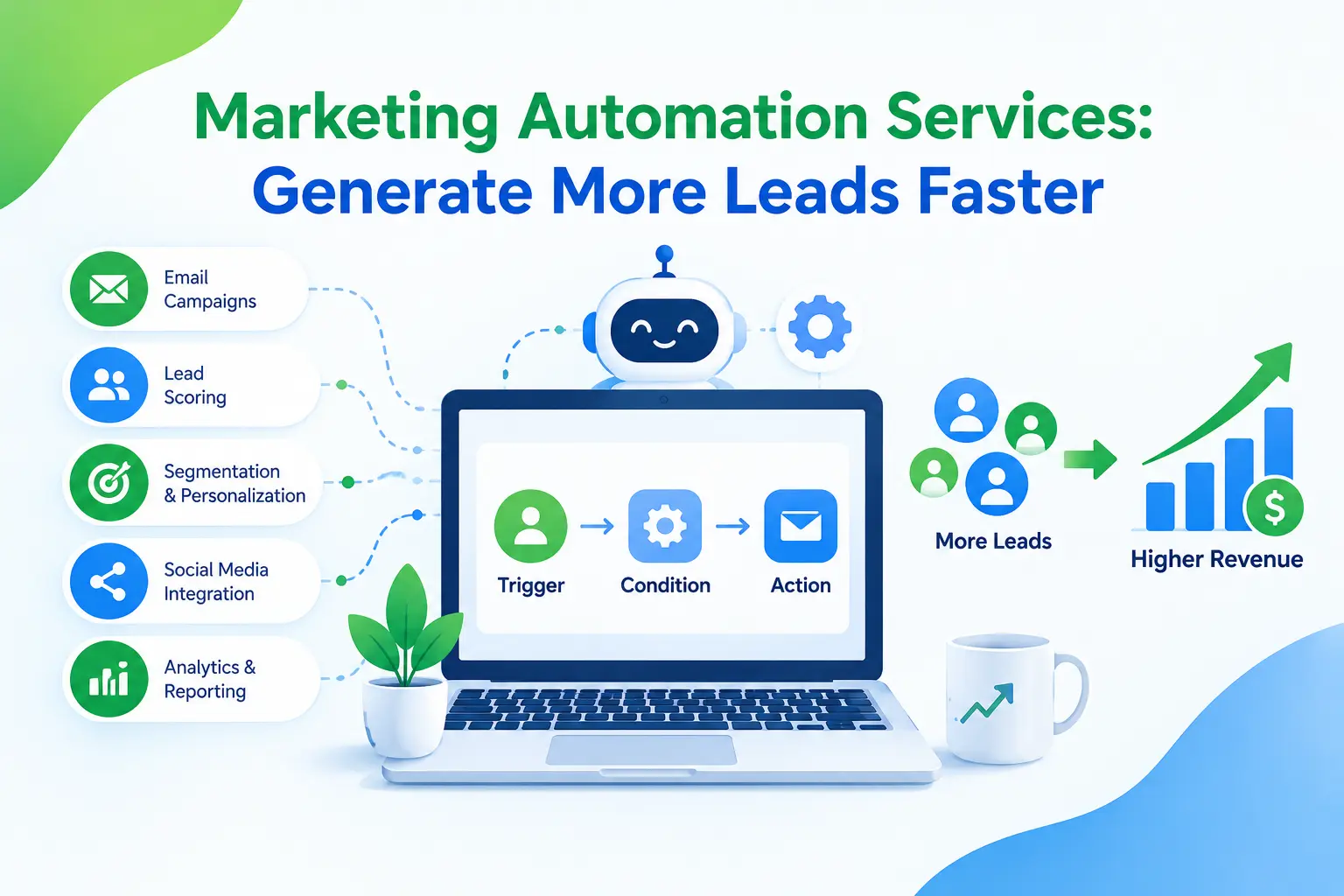
Each automated campaign has a trigger, a condition, and an action. A trigger is an action someone takes like downloading a guide, dropping a cart, or going to a pricing page. The system monitors conditions, such as their industry or their history, and then performs an action, such as sending a customised e-mail or alerting your sales team.
For example, when a downloadable ebook is downloaded, the system can mark them as interested in that topic, send them a three-part e-mail sequence, score them on their interaction with the e-mail, and alert a salesperson when they get to a certain point. All this is done automatically and in real-time.
Core features and services that you can expect are:
- Welcome series, nurture series, product announcements, and behavior-driven re-engagement campaigns—among other things—are examples of email marketing automation.
- Social media integration: Social media links and buttons.
- Video integration: Video integration and play buttons.
- Lead scoring and routing: Points given for activities like email clicks and page visits, prioritizing leads for your sales team.
- Segmentation and personalization: Messages are targeted to each audience based on interests, behavior and on the stage of the purchase journey.
- Marketing and sales tools automatically connected to CRM.
- Social Media Scheduling: Scheduling and posting a social media post without having to do it each day.
- Retargeting ads: Advertising to those who visited your site before.
- Analytics and reporting: Dashboards that provide insight into which campaigns are driving leads and revenue.
It is not necessary to have all features at first. It’s best to begin with two or three high impact workflows that deliver value to the business, such as a welcome series for new subscribers and a follow-up series for form inquiries and expand from there once it’s successful. This will keep the project manageable, and help you validate the return before committing more funds to the project.
Benefits of Marketing Automation
- Improved follow-up, more consistent: Follow-up is improved and consistent. The quicker the better with a prospect that has a keen interest. Automation can respond within seconds, maintain the conversation and never forget to ask a question, since someone was busy.
- Better Lead Nurturing: A lot of visitors aren’t prepared to buy on their first visit. Automated sequences can provide helpful information over time, fostering trust and keeping your business top of mind when they’re ready to make a decision.
- Higher Quality Leads for Sales: gain more leads from better sites. Lead Scoring identifies those visitors who are actively interested in your company, and not just window shopping. Your sales team’s time is no longer wasted on cold calls, but they are focused on closing warm ones.
- Personalization at Scale: Messages are more effective when they are personalized to fit the recipient’s needs. Segmentation allows you to send relevant content to thousands of contacts without having to write it in each message.
- Time and Cost Saving – 5.5.2: Basic emailing, record updates, and reporting are automatically performed. Your staff can concentrate on strategy and creative tasks, and you can expand your marketing production without expanding your staff.
- Clear, Measurable Results: All email, forms and campaigns can be tracked. You can see what works, what doesn’t, and make decisions based on data (not guesswork).
Linear marketing and business automation vs. business automation
Linear marketing automation versus business automation.
These two terms are correlated, but not synonymous. Marketing automation is all about attracting, nurturing and converting prospects via campaigns & communication. Business automation is wider and extends to the internal process like inventory, reporting, onboarding and billing. Many companies utilize both and the best results are achieved when there is data sharing between marketing, sales and operations systems.
The process of delivering Marketing Automation Services
- Strategy and audit: Your current marketing, audience, funnel and tools are assessed to identify the greatest opportunities.
- Goal setting: Clear goals are set, e.g. lead volume, conversion rate, or revenue per campaign.
- Platform Set Up and Integration: The selected platform is set up and integrated with your website, CRM, and other systems.
- Workflow and content creation: Campaigns, emails, landing pages, and scoring rules are created and written.
- Testing and launch: All workflows are tested prior to deployment so they function as expected.
- Optimization: Subject lines, timing, offers and segments are tested and improved based on actual results.
Regular updates are reported back with results and recommendations for the next steps.
What’s the Price of Marketing Automation Services?
The prices are determined based on the size of your contact list, the number of campaigns you run, the platforms used and the degree of support required. Usually, there are two cost elements to consider:
- Platform fees: Charges for using the software over the course of the month and usually hike up as more contacts are added.
- Service fees: One-off setup fees and/or monthly retainer fees for ongoing management.
In determining value, consider the return, not the price. Determine the Value of an additional qualified lead or recovered sale to your business and see how that value compares against the monthly investment.
How to Choose the Right Provider
- Strategy before software: A good partner asks about your customers and sales process before recommending a platform.
- Experience with the platform: They shouldn’t be promoting just one option that fits every client when it comes to the platform experience.
- Content ability: Automation is as good as what message it sends, so make sure they can craft and craft effective messages.
- Real world results: Request case studies with actual numbers (e.g., lead growth or revenue impact).
- Data and compliance knowledge: They need to know what consent and privacy mean and about email laws like CAN-SPAM and GDPR.
- Informative reporting: there’s always a reason why it’s working.
The following are some common mistakes to steer clear of
- The absence of a strategy on buying a tool: Software does not attract leads. A plan, offer, and content does.
- Sending to all: Unsubscribes and poor engagement due to poor targeting.
- Failing to maintain list quality: A smaller list, with engaged buyers, is better than a large list of unengaged buyers.
- Leave it alone: Campaigns must be evaluated and updated on a regular basis to be effective.
- Failure to align sales and marketing: There needs to be a consensus between marketing and sales about what constitutes a qualified lead.
Conclusion
Automation makes it possible to consistently follow up and communicate relevantly to website visitors, which is what helps convert them into customers. Your marketing continues to work for you 24 hours a day, while your team concentrates on building relationships and closing deals, with the right strategy, platform, and content.
When leads are losing, when your campaigns are too time-consuming or when things aren’t working well, it’s time to try a different system. We at GSS Tech specialize in both digital marketing and automation to ensure businesses can gather, nurture and convert more leads. Contact us today to talk about your objectives and the possibilities of automation for your business.
Frequently Asked Questions
What is marketing automation services?
Marketing automation services are professional programs that design, create and implement automated marketing campaigns including e-mail sequences, lead scoring, and retargeting to ensure that marketing tasks are automated and not continuously handled.
What is the common method which marketing automation uses to generate leads?
It collects visitor data on forms and landing pages, follows up with pertinent content, scores how visitors interact with it and notifies your sales team when a prospect is ready to speak with you.
Can Small Businesses benefit from Marketing Automation?
Yes. Small businesses benefit from automation often more than any other as they are able to deliver consistent follow up and campaigns, which would otherwise require more employees.
What is the price of marketing automation services?
Costs consist of subscription fees for the platforms and the fees for set-up and management of the services. The total will vary based on the size of your contact list, number of workflows and the level of support you need.
How long time to achieve results?
Simple workflows, like a welcome series, can be live in days. When campaigns are tested and tweaked, meaningful improvements in lead quality and conversions typically show up in 2-3 months.
So, what platform is the most ideal for marketing automation?
There is no one right answer. The tool you choose will depend on your budget, team size, CRM, and goals, so your provider should prescribe tools based on your needs.