


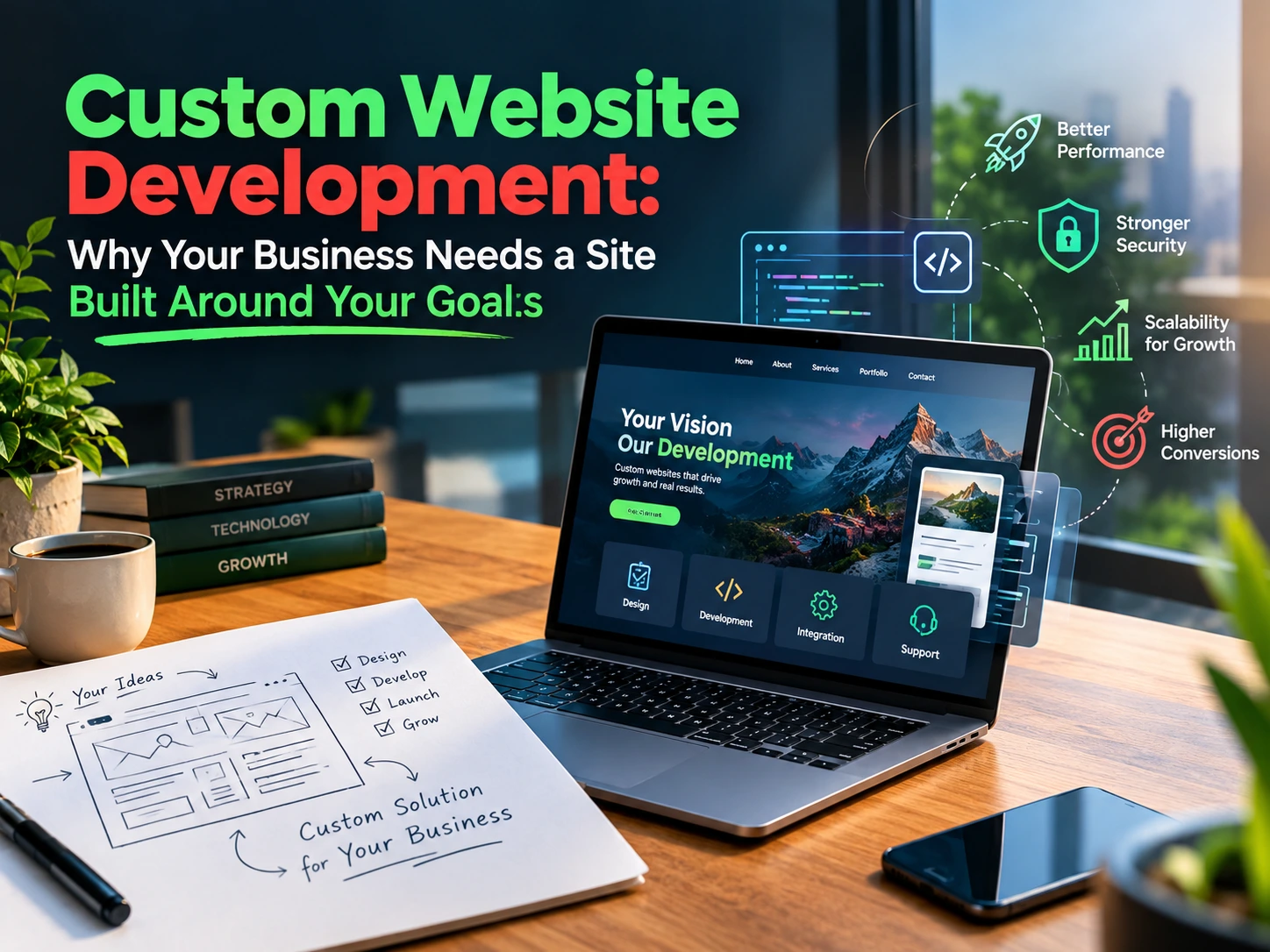
Custom Website Development: Why Your Business Needs a Site Built Around Your Goals
Custom website development involves designing and creating a website from scratch, making it your brand, your customers and your goals. The difference is significant for businesses that need their website to drive leads, sell products, or cultivate trust. A customised site is faster, it is easier to scale up and it provides you with complete control of the flow of visitors from your landing page to your enquiry.
We explain what custom website development is, how it differs from a template-based build, the cost, and how this process works, as well as how to ensure your new site ranks from the start with search engines and answer engines and is optimized for generative AI platforms.
Custom Web Development: What is It?
All of your custom site’s layout, navigation, database, features, and integrations are designed and coded to match your needs. A development team doesn’t build a site based on a set of pre-existing themes, but instead they research your consumers, track how they move around a site, and then design and construct the site to accommodate their journey.
Typical components of a custom build are:
- Original UI/UX design with Brand Identity
- Clean, well-structured front-end and back-end code.
- Bookings, calculators, client portals, dashboards, etc. (custom features)
- CRM, payment gateway, email platform and analytics integration
- The website structure from the get-go is built for technical SEO.
It works for expanding businesses, ecommerce companies, service-based businesses and any enterprise that outgrows the capabilities of a template.
Custom Websites vs. Template Websites
Templates are fast and cost-effective, which is a good option if it’s just going to be a simple first launch. The compromises will come as you start to see more traffic and more granular needs.
- Performance: Templates may also include unused code and plugins which slow pages down. A custom build has just what your site requires.
- Flexibility: Themes can only allow for certain features as templates. A custom site can handle any work flow and capability that you can imagine.
- Security: They are frequently targeted by attackers for some of the popular themes and plugins. Custom Code: decrease your exposure to known vulnerabilities.
- Scalability: Custom architecture is built to scale based on new pages, products, users, and integrations.
- Brand differentiation: Your website is different from the thousands of others who are using the same theme.
Pros of a custom-built website are numerous
There are a ton of benefits to a custom-built website.
- A Unique Brand Experience: Your website will represent your first impression to your prospect. A custom design allows you to manage typography, layout, movement, and tone, ensuring that the experience is uniform on all pages, whether they see a lot of visitors or few.
- Improved Load Times and performance: The speed of which your site loads impacts the user experience and even how visible your pages are on search results. Custom builds are easier to maintain a fast performance, contributing to better Core Web Vitals scores, as developers write lean code, optimize images, scripts, and hosting according to your site.
- Built-In Scalability: If your business expands, with added services, locations, or product lines, a custom site can grow without having to be rebuilt. This flexibility can help you safeguard your initial investment and maintain technology consistency with your growth.
- Stronger Security: Custom development can take security into account in the design phase, such as secure authentication, data handling, and regular security updates. Relying on third party plugins that can be abandoned and compromised.
- A solid SEO foundation: Structured URL, logical internal linking, structured data, mobile-friendliness, and crawlability can all be integrated from the initial line of code. This is much easier than having to add these elements to a template at a later date.
- Higher Conversion Rates: If the pages, forms and calls to action are tailored towards your customer’s behaviour, there is an increased chance of turning every visitor into a lead or a buyer. A few tweaks to the user flow can make a tangible impact to revenues.
The Custom Website Development Process
A well-run project is well organized, and you always know what is going on and what’s next.
- Discovery and strategy: The team gets to know your business, audience, competition and objectives, and establishes scope, features and success metrics.
- Sitemap and wireframes: Prior to any visual design, the structure of your page is mapped out along with the routes that users will take to get from one place to another to help you meet your goals.
- Design: Designers develop the visual identity, page layout, interactive components, etc. (Typically requires changes according to your suggestions).
- Development: Frontend, Backend, Setup Content Management System, Integrations.
- Testing: The site is tested to ensure speed, functionality, accessibility and security, across browsers, devices and screen sizes.
- Launch and optimization: Once the site is live, the team is monitoring performance, addressing issues, and optimizing the site based on the actual performance of visitors.
What’s the price of custom website development?
This is because each project is unique and priced accordingly. The cost of a focused business website with a few pages is much less expensive than a large ecommerce site with custom integrations and user accounts. The following are the key factors to consider when it comes to cost:
- The number of pages and templates needed
- The difficulty in designing and animating.
- Custom functionality, including booking, membership, calculator etc.
- Integrations and automation with third parties
- Content: creation, migration, and setting up SEO.
- Continuous hosting, maintenance and support.
Instead of paying merely the initial cost of the unit, think about the return on investment. If a site converts better, is ranked higher and does not require expensive rebuilds, over time, it will pay for itself. Request an in-depth, itemized proposal to ensure you understand what you’re paying for.
Optimizing for SEO, AEO and GEO
Search is changing. Nowadays, visitors can discover businesses via normal search results, featured snippets, voice search, and AI-powered tools that create answers straight from their script. They all should be supported by a modern website.
- SEO (Search Engine Optimization) is all about search result rankings. This translates to fast load speed, mobile-first, clean code, optimized metadata, descriptive headings, and an excellent internal linking structure.
- AEO (Answer Engine Optimization) is about being the first answer to a question. Have clear question-oriented headings, short answers at the beginning of each section, and FAQ content schema-marked to allow search engines to extract your answers.
- GEO is about being mentioned by chatbots like ChatGPT, Gemini, and Perplexity. These tools prefer a well-structured, factually accurate, authoritative, and consistent content across the web. Having well-defined terms, specific details, and credible sources all increases your chances of being referenced.
These principles can be incorporated into your project from the beginning; and it’s one of the best benefits of having a professional development team – they can be planned as a whole.
How to Choose the Right Development Partner
Who builds your site makes a huge difference on how quality the finished site will be. Here are some key features to consider when comparing agencies:
- An overview of real projects in your industry of interest
- A clear process with clearly defined milestones and communication
- Unlike coding, they should have an in-house team with a sound understanding of the design, development and optimization of your website.
- Evidence of outcomes including case study, testimonials and measurable outcomes
- Support, Maintenance and Training after the launch
- Ensure that code, content and data are owned by you;
A great partner will first ask what your business objectives are before discussing technology. Beware if an agency’s initial focus is on features and costs, before they get to know the target audience.
Conclusion
Your website is one of the most important assets your business has and it should work as hard as your best sales person! Custom website development provides you with a site built around your brand, your customers and your growth plans that is not as fast or secure or can’t match the search visibility that a template can provide.
Once you’re past the one size fits all site, the next step is to hire a team with a robust development and digital marketing background. At GSS Tech, we can assist businesses plan, design, and build websites that are optimized to rank, convert, and scale. Contact us to talk about your project and learn how custom-built website can help you achieve your goals.
Frequently Asked Questions
What does ‘custom website development’ mean?
Custom Website Development: It is the process of designing and coding a website, instead of using a pre-built template, to meet the specific needs of the business. It includes SEO structure, functionality, design and integration.
So, how long does a custom website take to develop?
The typical projects range from 4 to 12 weeks, depending on the size and complexity of the project. Typically, a small business website is faster, whereas a larger site with custom features or e-commerce may take a couple of months.
Should it be better for your website to be custom or not?
In most cases, yes. A custom build will give the developers the ability to influence site speed, URL structure, schema markup, and mobile responsiveness from the ground up, which will help them achieve higher rankings.
What is the cost of custom website?
The price can vary based on the number of pages, design complexity, features, and integrations. There are of course simple business sites which are lower, and advanced sites which are much more expensive. The best way to budget is to get a detailed quote depending on the requirements.
Is there a way for me to update my custom website?
Yes. Most custom sites come built-in with a content management system, allowing your team to edit out pages, post blog articles and update photos without coding. Your developer may be able to train you as well.
Need to have continuous service after launch?
Yes. You get regular updates, security checks, backups and performance monitoring – keeping your site safe and fast. Many companies offer maintenance plan services, which will allow you to focus on running your business.