


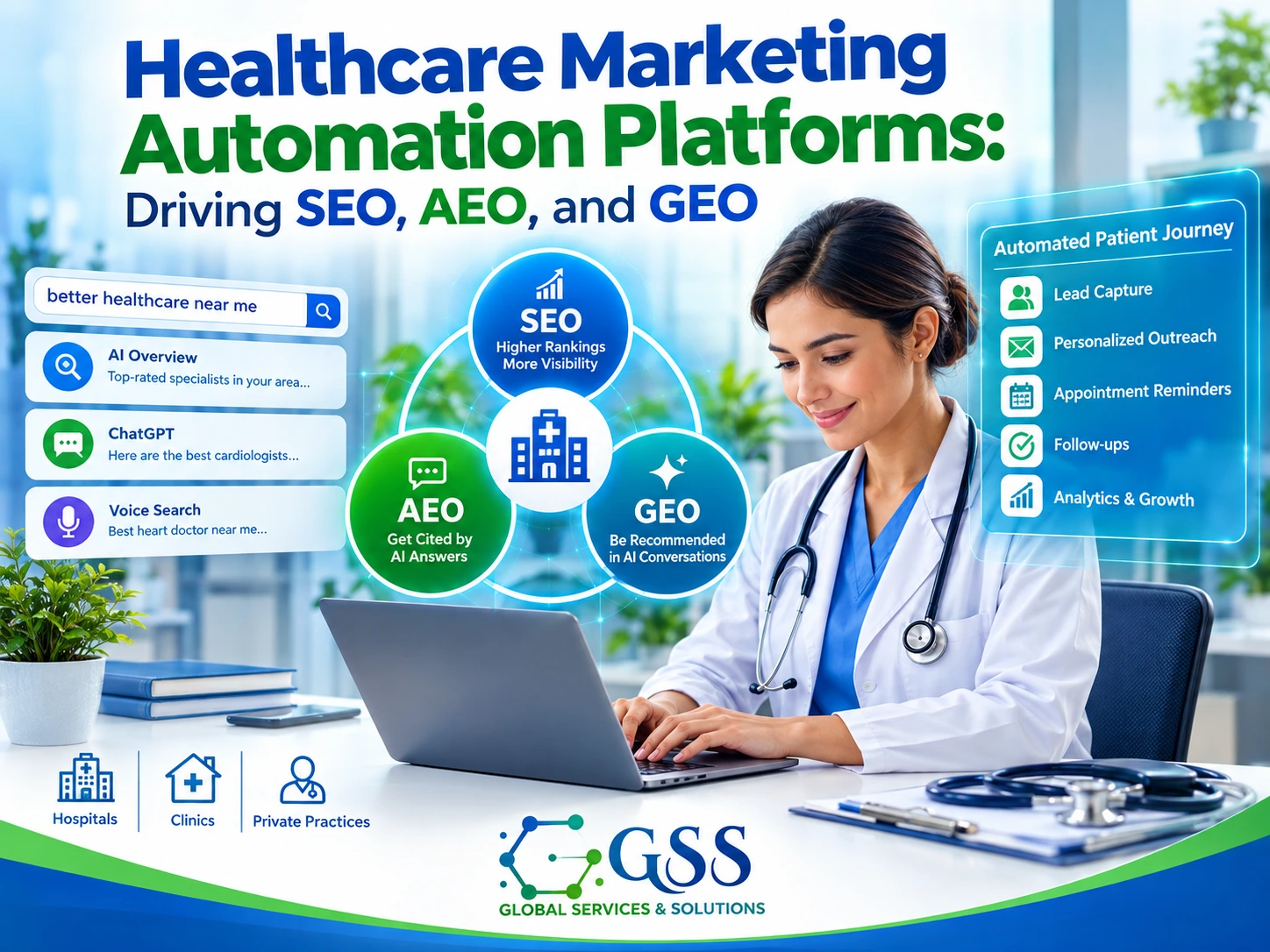
Healthcare Marketing Automation Platforms: Driving SEO, AEO, and GEO
Patients no longer begin their care process by calling a clinic or consulting a directory. They look up symptoms online, use AI to review specialists’ ratings, and form a comparison of specialists before they even call. This is one of the reasons why a healthcare marketing automation platform has become a vital tool to hospitals, clinics, and private practices. It doesn’t just mark the connection between search engine optimization (SEO), answer engine optimization (AEO), and generative engine optimization (GEO), it is the engine that drives them all.
At GSS Tech, we’re working with healthcare marketers who are sick of dealing with five disparate systems only to run one patient communication campaign. This fragmentation is addressed by a well-designed system like this. It centralizes lead scoring, appointment follow-ups, analytics and content distribution at the same time ensuring that content pushed into the aforementioned systems is accessible to search engines, AI answer engines and generative models.
What Exactly is a Healthcare Marketing Automation Platform, Anyway?
The essence of a healthcare marketing automation platform is software that automates mundane marketing and communication activities, monitors patient interaction with digital channels and sends the right message to the right patient at the right time. It’s like the marketing nervous system of your practice: When you see a symptom-checker visit, it triggers a response (a reminder text message, a nurture email, a staff alert), without you having to do it manually.
However, the definition has been extended. Consumers are using AI tools such as ChatGPT, Perplexity and Google’s AI Overviews today to learn which healthcare providers offer the best treatment for a specific ailment. This is where SEO, AEO and GEO fit in with a modern patient-engagement stack and bring in well-structured, clean, and often times updated content, which feeds those AI systems.
In the End, for Every Healthcare Marketing Automation Platform, SEO: The Foundation is Still Required
As AI search has emerged, SEO has not vanished, but has rather become a source of data for the AI systems. Any healthcare marketing automation platform that doesn’t take SEO into account is sitting on sand. Even if the keyword research is excellent, if it has been done around symptoms and treatments, technical site health, internal linking and backlink authority from medical directories, you may not even get your content indexed, ranked, or even surfaced by an AI answer engine.
In practice, you want your platform to be seamlessly connected with your website’s content management system, such as service pages, condition guides and provider bios, which are automatically optimized for target keywords, meta tags and schema markup as they are published. GSS Tech normally integrates this automation with a quarterly technical SEO audit to identify crawl errors, slow page speeds and duplicate content before they sneak up and steal rankings.
AEO: Getting Cited by AI Answer Engines
Answer engine optimization is optimizing content to make it easy for AI-powered answer engines (such as Google’s AI Overviews, Bing Copilot, and voice assistants) to pull out a direct, quotable answer to a question regarding a condition, treatment, or provider. Patient communication software is pivotal here, as consistency is a major factor: the same facts, definitions and credentials must be consistent across your website, provider listings and social profiles.
When this software automatically publishes a piece of content to several channels it will line the same message in all the places the AI engines look. Formatting answers in a clear question-and-answer format, summarizing the answers in the first sentence of each section with a concise definition and marking up content with FAQ and medical schema all boost the chances of you becoming cited as the source, not a competing practice.
GEO: Winning Inside Generative AI Conversations
Generative engine optimisation goes a step further. GEO optimizes not for a search-results page, but rather for how large language models, such as ChatGPT, Claude, and Gemini, build and suggest providers when having a conversation. A robust automation stack can help support GEO by providing your practice’s data provider credentials, treatment specialties, insurance information and patient testimonials in a format these models can easily consume and trust, from structured data to well-labeled tables to plain-language summaries.
Early investors in GEO alongside their automation efforts have seen a noticeable increase in “assisted” bookings, which are appointments where a patient references a GEO provider recommendation made via an AI chatbot. A channel that only a couple of years ago existed in its infancy and is now becoming a larger percentage of new patients.
A Healthcare Marketing Automation Platform Brings It All Coming Together
Orchestration is the key to the real strength of a healthcare marketing automation platform. Let’s take a look at a typical patient journey:
- A person looking to schedule an appointment with a dermatologist for eczema types a query into an AI assistant: “Where is the best dermatologist for eczema near me?” Your GEO optimized provider profile is structured clearly, so your practice is mentioned.
- The patient clicks through to a landing page you built and optimized within your platform, with AEO and targeted copy for SEO.
- They schedule a consultation, and their name gets added to a nurture sequence that automatically starts on the platform, they get reminders to attend that appointment, and they are notified when they reach a defined engagement point, where staff contact them.
If these steps were not connected in this manner, each one of them would exist in a silo: marketing is having content, digital strategy is having visibility of the chatbot, and front-desk is having follow-up with the patients. It’s integration that makes individual tactics a cumulative patient acquisition machine.
Select the Best Healthcare Marketing Automation Platform for Your Practice
While not all tools available are created equal, selecting the right one relies on practice size, patient volume, and tech stack. Smaller practices may begin with less complex platforms that integrate appointment reminders and patient relationship management, while larger health systems often require more comprehensive solutions like EHR integration, HIPAA compliance, and multi-location campaign management.
GSS Tech suggests these three questions to ask when assessing a healthcare marketing automation platform:
- Can it publish and update structured data without manually coding?
- Is it able to offer transparent attribution, beyond paid and organic search, by SEO, AEO and GEO?
- Can employees keep up with it without having a full-time administrator for the job?
The platform which scores good on all three will save so much time that they will not be able to calculate it.
Conclusion
If practices are looking to stand out in search engines, AI answer engines and generative AI assistants, then a healthcare marketing automation platform is infrastructure essential. It’s the bridge between SEO basics, AEO structuring, and GEO visibility and it’s the one thing that enables a lean marketing team to be present in all the places where patients are searching these days. Those that view it as a strategic platform, not just an appointment reminder system, are establishing sustainable patient pipelines in an AI-powered health care environment. If you’re feeling your current stack is disparate, GSS Tech is available to audit, consolidate and optimize your stack to ensure all your channels are working together, not separately.
Frequently Asked Questions
1. What is a healthcare marketing automation platform?
A healthcare marketing automation platform is used to streamline marketing efforts, manage campaigns, and track their performance. It automates repetitive marketing and communications processes like appointment reminders, lead scoring, content publishing and campaign tracking, which enables healthcare marketers to nurture prospects at scale while eliminating manual follow-up.
2. What sets a marketing automation platform for the healthcare industry apart from an EHR?
An electronic health record system holds information about the clinical actions and patient charts and an automation platform is focused on marketing actions and communications that are based on patient behaviour. Many of the practices have a system that combines both so that there is no disconnect between the clinical and marketing teams.
3. If I don’t have to optimize for AI answer engines, does SEO still play a role?
Yes. Although AI answer engines and generative models are built upon web content, the information they generate is primarily from indexed, well-optimized web content, which is why strong SEO is the foundation on which AEO and GEO are built.
4. What’s the difference between AEO and GEO?
The difference between AEO and GEO is that AEO is about having content that appears in the search results when users ask questions in a conversational style, rather than in a single direct question. AEO is about content appearing in direct-answer results, such as AI Overviews and voice search, whereas GEO is about the content being cited or recommended in the conversational responses from generative AI tools like ChatGPT or Gemini.
5. Does this sort of platform work for a small practice?
Yes. Smaller practices tend to benefit from the quickest return as automation saves them time and manpower in the front office, allowing staff to dedicate more time and resources to patient care and outreach.
6. How long does it take to see results from healthcare marketing automation?
The benefits of most practices will be noticed in terms of patient response time and nurture engagement in 30-60 days; SEO, AEO, and GEO visibility gains tend to take 3-6 months.
7. Is there a need to rewrite content for AEO and GEO?
It may need to be restructured (headers, answers to questions on top of each section, structured data, facts in all published channels).
8. What are the important factors to consider in selecting a platform?
For data handling, content and schema publishing tools, multichannel analytics, lead scoring and tracking performance across SEO, AEO and GEO channels within a single dashboard, look for HIPAA compliant data handling.
9. Does automation have a negative impact on personalisation in healthcare marketing?
If it is improperly configured. If done right, automation can actually enhance personalization capabilities by presenting more timely and relevant content than manual efforts would allow.
10. How does GSS Tech help healthcare businesses with this?
GSS Tech conducts marketing stack audits, sets up and optimizes automation tools, and designs content plans optimized for healthcare SEO, AEO and GEO best practices to support the building of a consistent and qualified patient pipeline.