


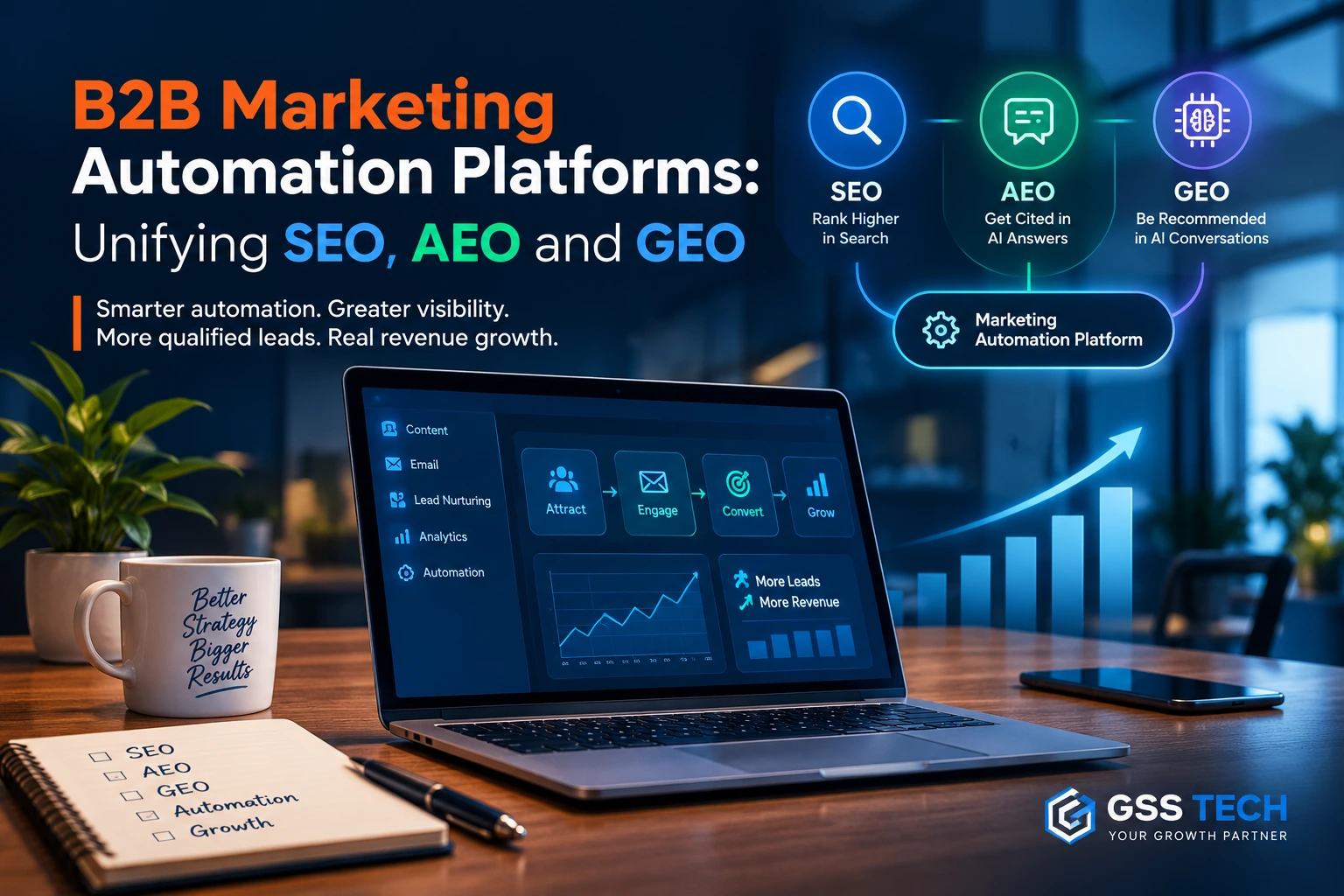
B2B Marketing Automation Platforms: Unifying SEO, AEO, and GEO
The way business-to-business (B2B) purchases are made has changed from five years ago. Procurement teams independently research vendors, seek assistance from AI tools for recommendations, and shortlist vendors prior to any sales contact. That is why a b2b marketing automation platform has become the foundation for today’s demand generation. SEO, answer engine optimization (AEO), generative engine optimization (GEO), and other search engine optimization disciplines are no longer separate; they are linked together under the umbrella of one unified growth strategy: It is no longer just a tool for scheduling emails; it is the engine that connects search engine optimization (SEO), answer engine optimization (AEO), and generative engine optimization (GEO), into one coordinated growth strategy.
At GSS Tech, we collaborate with founders and marketing leaders who are fed up with managing five separate tools to execute one campaign. This type of fragmentation is addressed by a well-designed system such as this. It streamlines content distribution, content scoring, email sequencing, analytics, and ensures that content fed into those systems is structured in a way that is understandable and citable by search engines, AI answer engines, and generative models.
What’s a B2B Marketing Automation Platform, Anyway?
A b2b marketing automation system is designed to streamline repetitive marketing duties, monitor client actions throughout channels, and provide appropriate substance to the appropriate shopper on the right time.
At its core, a b2b marketing automation platform is software that automates repetitive marketing duties, tracks shopper actions throughout channels, and provides the proper content to the right buyer at the right time. Imagine it’s the nervous system of your marketing operation: it picks up on signals (when someone downloads a whitepaper, views the pricing page, registers for a webinar), and activates responses (when someone downloads a whitepaper, views a pricing page, registers for a webinar), without any human touching a button at every point.
However, the definition has grown to encompass more. Buyers today research with ChatGPT, Perplexity, and Google’s AI Overviews before they even land on a web page to get vendor recommendations. It also involves providing those AI tools with clean, well-optimized and consistently refreshed content, something all these three disciplines of demand generation can deliver.
There is No Denying that SEO Plays a Crucial Role in Any B2B Marketing Automation Platform
SEO is an important part of any B2B marketing automation platform; there’s no denying it.
SEO is not going away because of the rise of AI search it’s the raw materials that AI systems are using. If a b2b marketing automation platform doesn’t support SEO, it’s a house built on sand. Even if you write a perfect piece of content, it’s still not guaranteed to be indexed, ranked, and even generated by an AI answer engine if you didn’t do keyword research, technical site health, internal linking, or backlink authority.
In practice, this should see your platform seamlessly connect with your content management system, meaning landing pages, blog posts and gated assets are automatically optimized for target keywords, meta tags and schema markup as they get published. Most of the time, GSS Tech will perform this automation in tandem with a quarterly technical SEO audit to uncover any crawl issues, page speed problems, and duplicate content before it sneaks up on them and quietly takes them by surprise.
AEO: Getting Cited by AI Answer Engines
AI Answer Engines can help you be cited on AnswerEngines.com.
Answer engine optimization refers to the optimization of content to enable AI-powered answer engines such as Google’s AI Overviews, Bing Copilot, voice assistants and more to be able to deliver a direct, quote-able answer. Marketing automation software is essential here because AEO requires consistency: the same facts, definitions, statistics should be featured on your website, knowledge base, press releases, and social profiles.
This software can automatically share the same piece of content to different channels, thus strengthening the same main message throughout the different channels. When you format your response(s) in a clear inbound and outbound flow, you’ll save the first sentence of a section as a definition, and mark it up with the FAQ schema, it’s more likely that your brand will be mentioned as the source, instead of a competitor’s brand.
GEO: Winning Inside Generative AI Conversations
Generative engine optimization goes one step further. GEO is built to optimize for a search results page, but optimized for large language models such as ChatGPT, Claude, and Gemini that synthesize products and make product recommendations in a conversation. Well-constructed automation support allows for the publication of your brand’s data case studies, product specifications, pricing logic, and customer testimonials to be easily understood and trusted by these models, in formats like structured data, well-labeled tables, and plain-language summaries.
Companies that invest in GEO at the same time as automation have experienced significant improvements in conversions with “assisted” conversions (when a prospect reports discovering the company through an AI chatbot recommendation). This is a channel that wasn’t really even around two years ago and is now being a bigger part of B2B pipeline.
How a B2B Marketing Automation Platform Brings It All Together
A b2b marketing automation platform is not so much about any particular feature, but about the orchestration. Think about a typical workflow:
- A prospective asks an AI assistant, “What is the best inventory management software for mid-size manufacturers?” Your case study is well organized and your brand is mentioned.
- After clicking, the prospect is taken to a landing page that you’ve created and optimized on your platform, with schema markup for AEO and copy optimized for keywords for SEO.
- They download a resource, and the platform automatically enrolls them in a nurture sequence, scores their engagement to a known level, and notifies sales when they reach a defined level of engagement.
If all these steps do not connect to each other in this type of platform, then each stage operates in a silo mode: the content resides in the SEO team, the chatbot visibility in another AI strategy team, and the follow-up to leads in the sales operations team. Tactics are not an engine for growth on their own; they’re only an engine if they’re integrated.
Selecting the Proper B2B Marketing Automation Platform for Your Business
Not all available options are created equal, and the best fit will vary based on company size, length of sales cycle, and the current tech stack. Smaller teams tend to prefer simpler platforms built on email automation and provide fundamental CRM features; enterprise organizations may require more extensive integrations with data warehouses, custom attribution modeling, and account-based marketing tools.
GSS Tech advises companies to ask three questions when choosing a b2b marketing automation platform:
- Can it publish and update structured data without involving the developer?
- Does it offer clear attribution beyond just traditional paid and organic search, across SEO, AEO and GEO?
- Can your team sustain it without a dedicated admin?
3 out of 3 is a platform you’ll save much more time on than investing time in it.
Conclusion
For businesses aiming to stand out in a crowded search engine, AI answer engine and generative AI assistant landscape, having a b2b marketing automation platform is no longer a luxury but a necessity. It connects SEO basics, AEO structuring and GEO visibility and it’s what enables a lean marketing team to appear on the scene all the time, where buyers are searching these days. Those companies that assign it the role of a strategic hub, and not just an email scheduler are the ones who are developing sustainable pipelines in an AI-influenced buying environment. If your environment appears disjointed, GSS Tech can help understand, streamline and utilize your stack to ensure all channels are working together, not separately.
Frequently Asked Questions
1. A b2b marketing automation platform is used for what?
Marketing teams can nurture leads at scale without having to do it manually, as it automates repetitive marketing efforts like email sequencing, lead scoring, content publishing and tracking campaigns.
2. A b2b marketing automation platform (b2bMAP) differs from a CRM in what way?
A CRM mainly stores and handles information pertaining to customers and the sales process, whereas an automation platform concerns itself with initiating marketing actions with a prospect once they have taken a specific action. Many companies use both, and seamlessly provide data from marketing to sales, and vice versa.
3. Can SEO be used for AI answer engines?
Yes. AI answer engines and generative models are very much built on top of well indexed and well optimized web content, so good SEO is the core from which AEO and GEO are built upon.
4. What is the difference between AEO and GEO?
Content that appears in direct-answer searches, such as AI Overviews and voice searches, is part of AEO, while content that gets cited or recommended in a conversational response from a generative AI model (such as ChatGPT or Gemini) is part of GEO.
5. Does such a platform work for a small business?
Yes. Smaller companies may benefit most from the return they experience as automation frees up their limited staff from menial and time-consuming activities, they can dedicate more time to strategy, creative work, and closing deals.
6. What is the timeframe for results of marketing automation?
Leads typically start to respond and engage with businesses within 30-60 days, and lead generation improvements from SEO, AEO, and GEO take 3-6 months.
7. Should there be any changes in the content for AEO and GEO?
Not completely rewritten, but frequently needs to be restructured; headers need to be clear, answers should be towards the beginning of a section, structured data markup needed, and the facts should be the same across all publishing channels.
8. What are some of the things I should look for in a platform?
Seek CRM integration, content/publishing tools, schema tools, multichannel analytics, lead scoring and SEO/AEO/GEO performance tracking on one dashboard.
9. Is automation proof of failure for personalization in B2B marketing?
If it’s improperly set up. When done correctly, automation helps personalization by providing more relevant content and timing than manual outreach efforts can offer based on behavior.
10. What does GSS Tech do to help businesses with this?
GSS Tech reviews current marketing systems, sets up and fine-tunes automation systems, and creates content marketing strategies in the context of SEO, AEO, and GEO best practices that enable clients to qualify the pipeline of B2B leads.