


How AI Search Is Changing SEO in 2026
If your traffic has changed from a few years back, then you’re not the only one. AI search is transforming how people search, and in 2026 it’s not a trend, it’s the main way a significant portion of your potential customers are searching. Companies that have relied on conventional search have begun to understand that artificial intelligence search works in a different manner and those that have made the most rapid transition are the ones benefiting. All businesses we support daily are striving to make sense of this shift, and you are not alone. You are not alone and at GSS (Global Services & Solutions) we work with them every day. This guide explains the entire landscape of changing SEO practices in 2026, including what works and what doesn’t, and what you should do about it.
Understanding AI Search and its Difference
AI search, which includes ChatGPT, Google AI Overviews, Perplexity, Copilot and more, are the new breed of search tools that provide a direct answer to a user’s query rather than a list of links to click through. Users no longer need to type some keywords and read a row of blue links; instead, they ask AI search tools a question and receive a synthesized answer right away.
This is the one that is driving the change in SEO. The traditional SEO evolved from the goal to achieve a high ranking in a list. AI search isn’t linear, it’s like a conversation. It’s no longer about just pushing keywords up to the top of the page, building backlinks, and achieving page-one rankings. Unlike traditional search, AI search does not prioritize position, but rather clarity, trustworthiness, and relevance to the user’s search query.
How AI Search is Transforming SEO in 2026
The Impact of AI Search on SEO in 2026
So what are the real difference(s) in SEO after AI search has become ubiquitous?
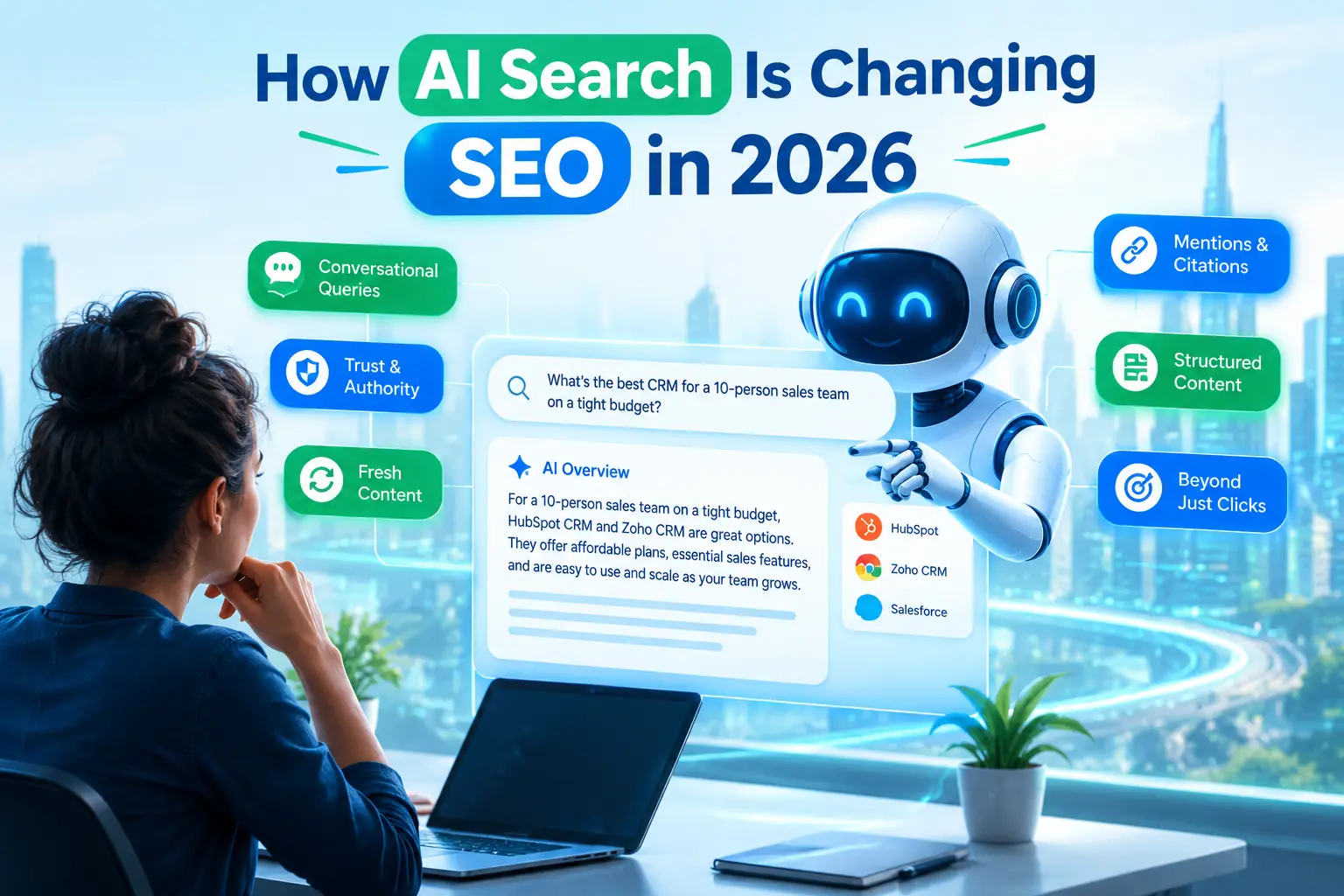
- The era of “zero click search” is here. With a larger percentage of queries answered by AI search that don’t lead to a site visit. The user gets their answer directly from the AI-generated summary. This translates to the fact that in 2026, SEO must consider visibility beyond the click: mentions and citations in AI search results have become a driver just as important as traffic figures.
- It’s not about the amount of keywords, it’s about the structure of your content. AI search tools prioritize content that provides a clear and concise answer to a question. Long pages that were previously successful in the past with traditional SEO can be completely overlooked by AI search since it prioritizes quick answers, frequently asked questions, and structured headers.
- Authority is not just your site, it’s the entire website. The more your business is mentioned across review sites, industry publications, and directories, the more frequently AI search mentions your business in its answers.
- Freshness is more important. Unlike traditional search engines, AI search tools are not as tolerant of out-of-date information. The likelihood of surfaceing content by AI search is much lower when it hasn’t been updated for a year or more, as generative models are often updated.
- Conversational queries have been replaced with short keywords. Users are no longer looking for best CRM software. They ask questions such as, “what’s the best CRM for a 10-person sales team on a tight budget?” to AI search tools. The goal of SEO in 2026 is to create content that truly addresses these kinds of questions, rather than focusing on short-tail keywords.
- Trust signals are more important than ever. AI search engines are not prone to relying on dubious or inadequate sources. The trust in your site from AI search is influenced by the clearness of authorship, transparency of business information, and consistency and accuracy of content.
Why Traditional SEO is Not Enough These Days
Don’t despair of the death of traditional SEO because technical aspects such as site speed, mobile-friendliness, and the cleanliness of site structure continue to play a pivotal role, and are also crucial for AI search success. In 2026, traditional SEO is still valid, but it’s not enough. A huge percentage of the buying journey has been moved into AI search and if your content isn’t created with AI search in mind, you’re invisible in the moments when a prospect is deciding who they can trust.
That’s why the combination of traditional SEO with a specific AI search strategy, often called AEO (Answer Engine Optimization) or GEO (Generative Engine Optimization), is becoming increasingly common among businesses to ensure they are found no matter where or how people look.
When AI search is there, what does a Strong SEO Strategy look like?
A successful SEO strategy for 2026 will involve the following:
- Front loaded answers to common questions, because AI search usually takes the first obvious answer it encounters on a page.
- FAQ pages created according to the real-life questions that customers ask AI search tools.
- FAQ pages designed around actual, natural questions customers ask AI search engines.
- Storing of structured data and schema markup that helps AI search understand what the page is about.
- Fresh and up-to-date information, as AI search algorithms prioritize freshness over outdated content.
- Favorable off-site signals, such as directories, reviews, and mentions, on other reputable websites that bolster the authority signals AI search prioritizes.
- Natural, human-sounding writing: AI search has improved so well it can identify and de-prioritize robotic, keyword-stuffed content now.
Businesses are feeling the impact of AI search first
Businesses feel the impact of AI search first. While some sectors are feeling the impact of AI search more than others:
- B2B Software and Services — Buyers often rely on AI search to do a comparison shopping before even hitting a vendor’s page.
- Healthcare and local services — Users are asking more specific questions to AI search engines about healthcare and local services.
- E-commerce — Product comparisons and recommendations easily fit into the way AI search provides answers.
- Professional services — Companies that create content that is concise and has questions embedded within it are receiving more citations from AI search than those that have pages filled with jargon.
Here are some typical pitfalls businesses can fall into when using AI search and SEO in 2026
- In the event that there is no change. Others are still practicing the same SEO strategy they used five years ago and are still asking themselves why their traffic is not increasing. There are still some companies continuing to use the same SEO strategy their top of the line 5 years ago and they are still wondering why their traffic is not improving, but don’t realize that AI search has changed how visibility works.
- Following rankings rather than citations. Having a high rank on a Google page 1 is important, but if your content isn’t written with AI search in mind, it can still be well-positioned, but the searcher’s answer may not include you.
- Ignoring off-site mentions. AI search isn’t limited to just your own site. Focusing solely on optimizing their own pages is throwing away opportunities for visibility when it comes to their online presence.
- Allowing content to become obsolete. Outdated blog posts and service pages negatively affect you more in the face of AI search than they did in the days of traditional forms of SEO, because freshness is now a much greater trust signal.
How to make your SEO strategy ready for AI search engines?
Making your SEO strategy AI search engine ready.
When you’re building a new SEO approach around AI search, focus on your best-performing and conversion-focused pages. Determine which pages do not have clear answers and which pages are out-of-date or poorly structured and address those pages first. Then, move on to FAQ content, schema, and an overall off-site presence to enhance authority signals that AI search relies on.
Conclusion
AI search is more than just a fleeting trend; it’s a revolution in the way people locate information, and it’s transforming SEO in the process. In the future, AI search will keep recommending businesses that take the time to think through their answers, build a solid structure, and maintain consistent authority signals. The ones that continue to play their old game risk going out of sight at the right time and the wrong place for their clients.
We help businesses develop SEO strategies that are informed by the way people search today and integrate the technical aspects of classic SEO with the content structure and authority signals that AI search focuses on. When you’re ready to ensure that your business is at the forefront of every AI search, reach out to Contact GSS today for a complimentary consultation.
Frequently Asked Questions (FAQ)
What is AI search?
AI search is a type of technology that gives the user direct and synthesized answers to their query, rather than a list of links they have to click through to find.
What are the differences between AI search and traditional search engine?
In the case of AI search, the answer might not include any links and can be constructed by analyzing multiple sources, whereas traditional search engines provide a list of links in a rank-order sequence.
In the era of AI search, is traditional SEO still relevant?
Yes. Technical SEO basics such as site speed and structure continue to play a role in the accessibility and understanding of your content by AI search, but must be complemented with the creation of AI search-optimized content.
How does AI search affect my website traffic?
With AI search offering users direct answers rather than links to websites, businesses are experiencing an increase in visibility for their content in the “zero click” search results and a change in traffic sources.
What are the best practices for optimizing content for AI search?
Be sure to prioritize clear, direct answers, well-organized FAQ pages, timely updates, and consistent branding and references to your business on other reputable websites.
Will AI search be a more significant factor going forward?
Yes. With the growing number of users turning to AI tools for research and decision-making, AI search is poised to become a more integral part of the user’s experience when finding businesses, products and services.
Does GSS enable businesses to optimize for AI search?
Yes. With the changing dynamics of search, GSS crafts SEO programs that align with the way AI search works, ensuring businesses remain discoverable and relevant. Contact GSS for more information.