


The Future of Medical Practice Growth: Mastering SEO, GEO, and AEO for Medical Clinics
The way healthcare organizations build their online presence is changing rapidly. One of the best ways to bring patients in for years has been old fashioned Search Engine Optimization (SEO). If you found yourself on the first page of Google for targeted keywords, your waiting room remained full.
The patient’s search for health care has changed dramatically. Patients are now speaking directly to voice assistants, posing complex questions to AI search engines, and searching for nearby clinics through interactive maps, rather than typing, and searching for short phrases in standard search boxes.
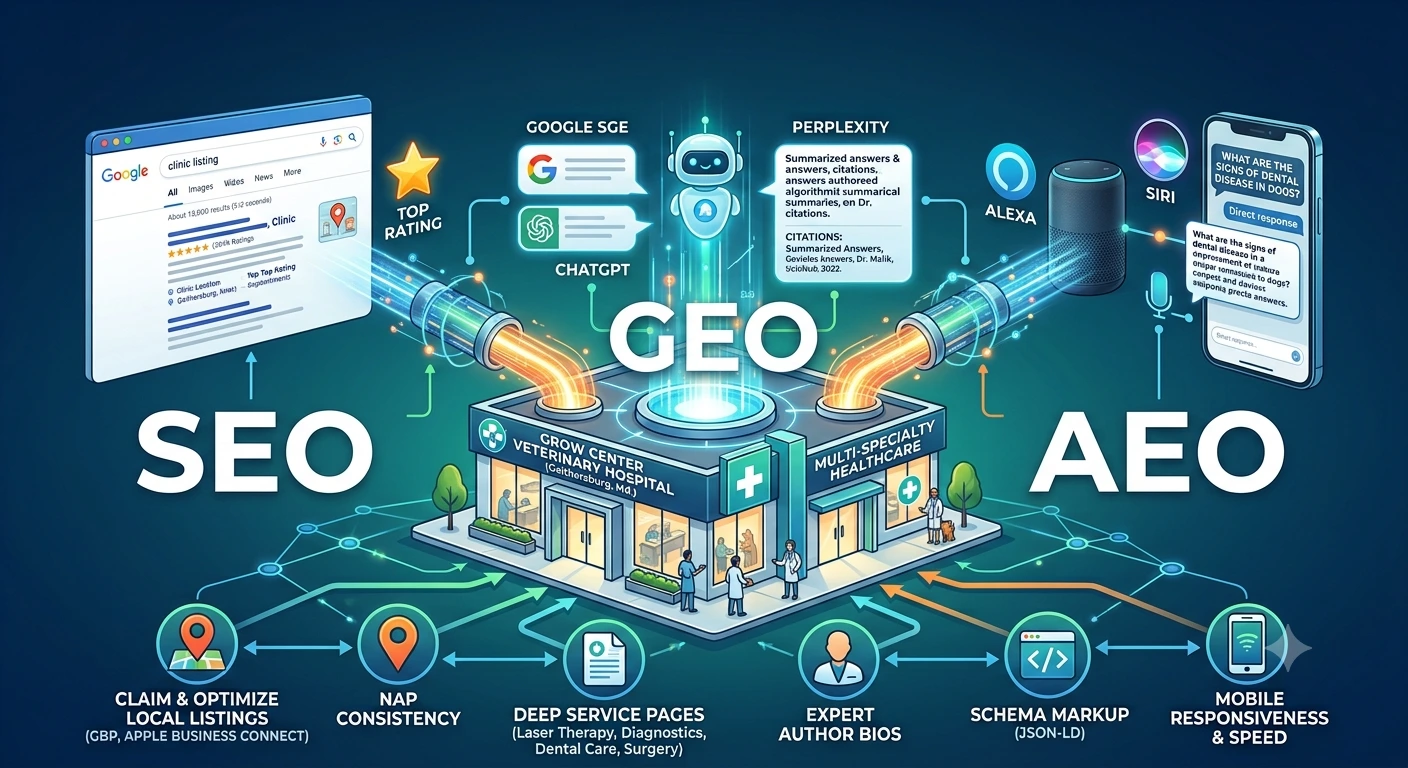
To prosper in this environment, medical practices and digital agencies such as GSS Tech Solutions need to add new strategies to their marketing toolkit. In today’s medical marketing digital world, you need to have a combined approach of traditional SEO, Generative Engine Optimization (GEO), and Answer Engine Optimization (AEO).
Whether you’re a small animal veterinarian such as Grove Center Veterinary Hospital in Gaithersburg, Md., or a multi-specialty human healthcare clinic, this all-encompassing guide will give you the tools you need to make your digital presence future-proofed for the future of search.
1. The Core Pillars of Modern Medical Search Optimization
This section teaches the Core Pillars of Modern Medical Search Optimization. This section teaches the Core Pillars of Modern Medical Search Optimization.
Understanding the dynamics of search visibility requires an understanding of the interaction of different optimization frameworks to create a unified clinical growth strategy. Let’s dissect the three different ideas that govern the way your practice is found on the web.
Search Engine Optimization (SEO)
SEO targets traditional search engine results pages (SERPs). The aim is to create site authority, technical structures, and rank for high-intent keywords, such as “best medical clinic near me” or “veterinary hospital in Gaithersburg”. It focuses on the common factors such as good backlink profiles, quick page load times, consistent headers, and tidy keyword maps.
Generative Engine Optimization (GEO)
GEO fine-tunes your website content for easy reading, citation, and summarization by generative AI search platforms like Google’s Search Generative Experience (SGE), Perplexity AI, OpenAI ChatGPT, and Anthropic Claude. GEO doesn’t rely on the ranking of links, but rather relies on your brand being the ultimate reference that an AI uses to build an answer for a user.
Answer Engine Optimization (AEO)
AEO is about creating your content to solve specific and direct queries. Think of platforms such as Amazon Alexa, Apple Siri, Google Assistant, or Google’s featured snippets. If a patient asks the question “What are the initial signs of dental disease in dogs?,” AEO ensures that your answer is perfectly formed, easy to read, and perfectly conversational, so that the voice systems can read it out loud upon request.
2. Establishing High Impact Local SEO Basics
You need to have your base local search practices fully optimized before you start targeting AI engines. The medical clinic is linked to a physical community. With no physical presence, generative models will have difficulty finding and trusting your brand.
Optimized Website Structure → Optimized GMB Profile → Local Citations (NAP Consistency) → Patient Reviews
Claim & Polish Local Listings
The key trust anchors for local search are your Google Business Profile (GBP), Apple Business Connect, and Bing Places profiles. Complete all of the fields:
- Choose your primary category carefully. (such as ‘Veterinary Hospital’, ‘Medical Clinic’ or ‘Pediatrician’).
- Operating Hours: Maintain up-to-the-minute seasonal or holiday hours.
- Services: Include details of medical services, diagnostic testing, and specific wellness services.
- Images: Post high-resolution photos of your lobby, clinical equipment, and staff to help familiarize patients.
Absolute NAP Consistency
Your Name, Address and Phone Number (NAP) should be consistent across all online listings. Small variations in the names, such as using “Gaither Rd” on your website and “Gaither Road” on Yelp, can reduce local search equity. Search algorithms don’t always agree with one another; this decreases your reliability rating.
3. Crafting Content for Generative Engine Optimization (GEO)
Generative AI search engines are not like traditional search crawlers. They look for authoritative information on the web to answer complex queries from the user. For instance, if one enters, “A vet clinic that provides laser therapy in Gaithersburg that has great reviews is needed”, an AI engine will create a customized paragraph by referencing the most authoritative sources.
You can ensure that your clinic is cited by generative engines by making the following three changes to your structure:
Use Authoritative Statistics and Original Citations
AI models appreciate information and openness. Base the informational pages on clinical facts. In case your team is a pet care group, you should include information about the long-term health risks that can be reduced with regular checkups, based on specific organization data from groups such as the AVMA or CDC. The more distinctive you are as a data provider, the more likely AI platforms are to cite you as an authoritative data source.
Medical Content Rigor (YMYL)
Medical questions are categorized into “Your Money or Your Life” (YMYL) by Google and AI platforms. Content that concerns the health of users must be based on the most rigorous of evidence.
- Include author bios for all health articles, these should be written by or reviewed by a qualified medical practitioner, such as Dr. Malik.
- Direct Credentials: Reference to certifications, degrees and medical professional associations.
- Real Clinical examples (First-Hand Experience): When it comes to an in-house procedure, the process can be explained in a step-by-step manner, which AI tools simply can’t replicate that.
Create Content for Algorithmic Scanning
Make it super easy for an AI to read your content. Use bullet points to interrupt long lists of text, bold text to highlight important words, and bullet points to summarize content on long pages. The clearer your formatting, the more your AI engine can chop up your content into a summary block.
4. Matching Conversational Search Intent for AEO
Matching conversational search intent is a key aspect of Answer Engine Optimization (AEO) and structuring content for it. People do not type the words of the keywords in voice search or chat boxes. Rather, they ask full-length questions in the long tail.
| Traditional Keyword Search | AEO Search |
|---|---|
| Vet diagnostics Gaithersburg | Where can I get state of the art diagnostic tools for my sick pet in Gaithersburg? |
| Dog dental cleaning cost | How often should I clean my dog’s teeth at the vet? |
| Open hours at emergency clinics | What is the emergency hospital’s hours near my location right now? |
Restructure your content around a “Question-First” approach:
- Use H2 or H3 Headers for Questions: Use subheadings that are the same exact words a patient would use when speaking them out loud.
- Give a 40-50 word Direct Answer: Just below the header give a brief, factual answer. This generates the ideal text snippet for voice assistants to pull out.
- Expand the Snippet: If users will be reading the full page, add more details, bullet points or process maps below the concise statement. Without high-quality content, search bots will get into code snares, so you will not be ranked.
5. Technical Foundations
Schema Markup
Schema markup is microdata that you can put on your site that allows search platforms to better understand the actual meaning of your site. MedicalClinic or VeterinaryCare structured data in the form of JSON-LD explicitly informs search platforms your actual location, medical specialties, accepted payment methods and staff credentials. This means that your clinic’s information is now immediately machine-readable, ready to seamlessly integrate into the conversational answer engines.
Prioritize Mobile Responsiveness and Core Web Vitals
More than 65% of local health care searches take place on mobile devices. A parent with an emergency family situation, as well as a pet owner with emergency pet needs a fast, intuitive mobile site. Ensure your image sizes are optimized,use clean code, choose fast web hosting and make sure that all the text is readable on every screen size to reduce bounce rates and increase conversions.
6. Case Study: Grove Center Veterinary Hospital
Let’s examine how established practice can implement these ideas with an actual practice’s digital footprint, Grove Center Veterinary Hospital.
The task was to transform the website of a well-established, small animal practice in Gaithersburg, Maryland into highly visible digital presence on both the traditional Google search results and the local voice search results, as well as in AI search responses.
The workflow for building Dedicated Service Hubs for local and clinical schema goes like this:
Execution Blueprint > Inject Local & Clinical Schema > Build Q&A Content for Conversation >
- Action Step 1: Deep Service Pillar Pages. The clinic should have rich, separate landing pages for specialized services such as Laser Therapy, Diagnostics, Dental Care, and Surgery rather than all services being categorized in one.
- Action Step 2: Use Local and Medical Identifiers. Embed accurate geographical terminology and clinical information into pages. For instance, “Grove Center Veterinary Hospital offers high-tech veterinary care for small animals, such as laser therapy and diagnostic testing, to homeowners in Gaithersburg and its surrounding Maryland neighborhoods.”
- Action Step #3: Emphasize Real Staff Experts. Connect your content to your in-house health care team. Include real case notes from your team (Dr. Malik, Angelina, Margaret, Crystal and Izabella) to convey medical trust, medical authority and real expertise to crawling algorithms.
This way of structuring sites gives small businesses and healthcare practices the exact cues that traditional search engine bots and generative search engines search for.
8. Clinic Optimization Checklist
Conduct an 8-point checklist of how well the clinic has been optimized. You want to ensure that your clinic is prepared to receive the next generation of online search traffic so you should go over this quick execution checklist:
- Own and optimise all local profiles (Google Business Profile, Apple Business Connect, Bing Places).
- Make sure your Name, Address, and Phone Number (NAP) is consistent throughout the Internet.
- Develop and create personalized in-depth service pages for each key medical service.
- Write out explicit bios for educational health articles as author, for all articles.
- Include structured schema markup specific to a medical practice in the page’s HTML.
- Rewrite key landing pages to have question-and-answer type headings as the first thing.
- Improve mobile site speed for quick access to emergencies.
- Optimize your clinic for the next generation of online search traffic by going through this quick checklist: Claim and standardize all local profiles (Google Business Profile, Apple Business Connect, Bing Places) and make sure that your Name, Address, and Phone Number (NAP) are all the same on the web.
A comprehensive, digital marketing strategy will allow your clinic to retain high visibility on the Internet and ensure that your patient flow is constant for many years.
The Frequently Asked Questions (FAQ Section)
What is the difference between SEO, GEO and AEO?
The emphasis of SEO (Search Engine Optimization) is on ranking web links for certain terms with traditional search engines. GEO (Generative Engine Optimization) optimizes website content for AI systems such as ChatGPT and Google SGE to ensure it is curated, summarized and cited. Answer Engine Optimization (AEO) optimizes content for the clear answers only when people use voice search assistants, such as Siri and Alexa.
Why are medical practices so in need of GEO digital marketing?
In the modern healthcare landscape, patients are turning to AI platforms for information on health symptoms and finding local healthcare providers, making GEO essential for medical practices. Without clear facts, verified author credentials and clean structures, your medical site content will be ignored when generative engines compile a synthesized answer for prospective patients.
What are the benefits of schema markup for my clinic?
Schema markup gives search engines a clear, structured context. Explicit code labelling on your clinical, medical and team credentials eliminates the guesswork for search algorithms. This makes it more likely that you’ll be found in rich snippets, interactive local map packs and voice assistant responses.
How many times a month should a clinic change its website content to optimize its search results?
A medical website needs to be checked every 3-6 months to ensure accurate information, security, and search results. Medical guidelines change, and you can let search engines know that your site is a current, reputable source of information by regularly updating team bios, active services, local hours and patient education articles.